Home > How Nigeria’s Kano state is using digital tools to transform teacher coaching
How Nigeria's Kano state is using digital tools to transform teacher coaching
26th June 2026
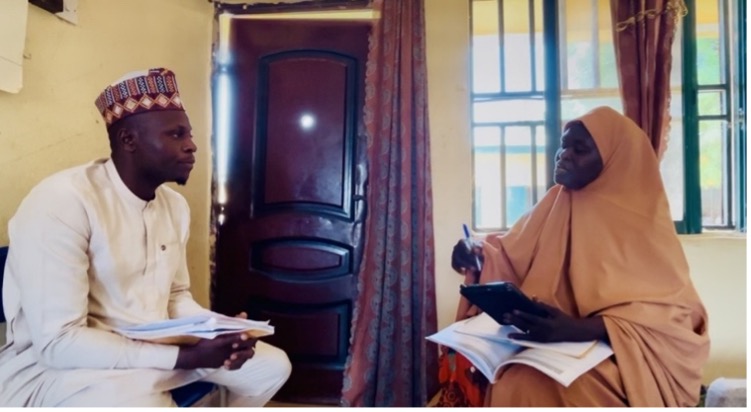
School Support Officer Rabi Dan Iya (right) coaches Musa Usman, head teacher of Amsharo Special Primary School in Nigeria’s Kano state. Photo credit: FHI 360 UK
It’s early morning in Nigeria’s Kano state, and an instructional coach is heading to a government primary school to complete a classroom observation. She visits the principal’s office, greets the teacher, then takes a seat at the back of the class. She observes a literacy lesson, makes notes in a checklist, then meets with the teacher for a reflective discussion.
What makes this coaching process special? The instructional coach — called a School Support Officer — is equipped with a digital coaching tool. The tool was introduced by the Partnership for Learning for All (PLANE) program, funded by the U.K. Foreign, Commonwealth and Development Office and implemented by DAI with FHI 360 UK as technical co-lead. It provides a simple lesson checklist, offers tailored coaching suggestions, and uploads the School Support Officer’s observations to a dashboard for easy analysis.
Using the tool helps School Support Officers improve classroom practices — and its impact goes beyond the classroom, too. Local Government Area officials can see which teachers need more support and better understand the challenges they’re experiencing.
“For the first time, I feel our work is visible and contributes to decisions beyond our LGA (Local Government Area),” says Tukur Ali, School Support Officer from Minjibir Local Government Area.
Shift from paper to digital helps reduce reporting delays
For years, school support visits in Nigeria depended on paper-based tools. These had limited effectiveness, since they delayed reporting and feedback to teachers and others in the education system. And with no standardized approach to coaching or reporting, it was difficult to see patterns across schools and act quickly based on what School Support Officers discovered during visits.
The tool — which works on tablets and Android phones — includes a standardized set of indicators, enabling real-time data capture and improving visibility into coaching and mentoring activities across schools. FHI 360 UK, through the PLANE program, introduced it to Local Government Areas across Kano, Kaduna and Jigawa states. Now, these state governments own the data, strengthening the broader education system through more consistent implementation and responsive decision-making.
Ownership and scaling in Local Government Areas
Members of the Kano state government quickly saw the value of the digital approach. They chose to adopt it, scaling it from the original four PLANE Local Government Areas to all 44 Local Government Areas in the state.
“Scaling up is critical as it allows the government to assume ownership of the coaching and mentoring activity in schools,” says Musbahu Sahabi, who worked on the PLANE project in Kano state. “When the government owns the program, it can ensure that [the activities] are focused on specific national priorities.” This way, says Musbahu, “literacy and numeracy skills improve.”
The government funded the necessary components for expanding the project, including training 440 School Support Officers and securing 280 tablets and a subscription to Power BI to support data visualization and reporting.
FHI 360 UK’s team showed government staff how to use the tool and the data collection process, then provided them with a training manual to help them scale the tools to the rest of the state. With government partners leading the way, the effectiveness of coaching and mentoring is already being seen and felt throughout the state.
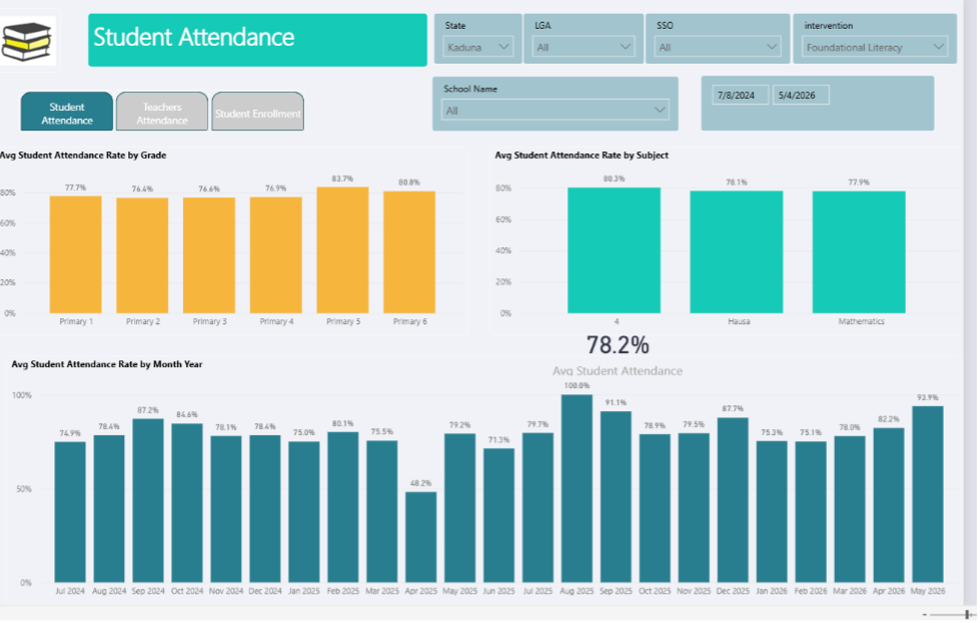
A screenshot of the dashboard, which displays data on student attendance, textbook availability, pedagogy practices, and frequency of school meetings.
Now, government partners can review dashboards to quickly identify challenges, and School Support Officers are better able to help teachers improve practices.
“The training helped me move from inspection to actually supporting teachers,” says Zuwaira Salisu, a School Support Officer in Gabasawa Local Government Area.
This experience in Kano state is a reminder that real reform is about strengthening the education system so that it works at all levels.
“A trained School Support Officer doesn’t just tick registers — he owns the school’s success like it’s his own child,” says Hajiya Hawwa Tanimu, director of teacher professional development at Kano’s State Universal Basic Education Board. “When School Support Officers own the process, the State Universal Basic Education Board owns the results and people own the progress.”
The process works well, says Hajiya, because School Support Officers shift from being seen as “outsiders who inspect” to “partners who take responsibility.”
“When School Support Officers are well-trained, teacher attendance rises because they feel supported,” says State Technical Advisor Zainab Isah Arah. “And when teachers show up and teach well, our learning outcomes improve.”
Improved learning outcomes create pathways to earning, strengthening economic resilience for individuals, families, and communities.
“Foundational literacy and numeracy are more than basic learning skills; they are the building blocks of economic resilience,” says Salim Sadiq, FHI 360 education coordinator.
“When children learn to read, write, and work with numbers, they gain the tools to adapt, earn, innovate, and thrive in an ever-changing world.”
Frequently asked questions
How does the digital teaching coaching tool used in Kano state work?
The digital coaching tool operates on tablets and Android devices, allowing School Support Officers (SSOs) to replace paper-based checklists with a standardized set of indicators. It enables real-time data capture during classroom observations, offers tailored instructional coaching suggestions, and automatically uploads findings to a Power BI dashboard. This dashboard provides local government officials with immediate visibility into pedagogy practices, student attendance, and textbook availability.
What is the PLANE program in Nigeria?
The Partnership for Learning for All (PLANE) program is a multi-year initiative funded by the U.K. Foreign, Commonwealth and Development Office (FCDO). It is implemented by DAI, with FHI 360 UK serving as the technical co-lead. The program supports the Nigerian government in delivering sustainable improvements in foundational literacy and numeracy skills for children in northern Nigeria, specifically operating across Kano, Kaduna and Jigawa states.
How has the Kano state government scaled digital education tools?
After an initial pilot by the PLANE program in four Local Government Areas (LGAs), the Kano state government assumed full ownership of the initiative and funded its expansion to all 44 LGAs. This scaling effort included procurement of 280 tablets, subscriptions to Power BI data visualization software, and the training of 440 local School Support Officers using technical manuals developed by FHI 360 UK.
Few investments can generate trillions of dollars in economic returns. Education is one of them. Read the blog by FHI 360 UK Associate Director, Education Holly-Jane Howell to learn more.
HSP champions One Health to fortify ASEAN against pandemics and climate-driven threats, viewing One Health as essential for multisectoral, equitable, climate-aware action via UK-ASEAN ties. We fund projects that embed OH across grants and peer exchanges for priorities like zoonoses, emergency response, AMR, climate-health risks, workforce development, digital health, and food safety.
Few investments can generate trillions of dollars in economic returns. Education is one of them. Read the blog by FHI 360 UK Associate Director, Education Holly-Jane Howell to learn more.
The ASEAN-UK Health Security Partnership (HSP) is a five-year initiative focused on strengthening health security and improve equitable access to primary care across the ten ASEAN member states and Timor-Leste.
The UK FCDO-funded Partnership for Learning for All in Nigeria (PLANE) Programme is a seven-year programme that supports and realises the Federal Government of Nigeria’s commitment to delivering sustainable improvements in learning outcomes for all children in Nigeria.
ISNAD is a key component of the UK Government’s support to the Palestinian Authority, working with the Palestinian Authority to build the capabilities of ministries to move towards fiscal sustainability, increased accountability and improved delivery of public services to Palestinians by reforming the core cycle of planning, budgeting and monitoring of government service delivery.
HSP champions One Health to fortify ASEAN against pandemics and climate-driven threats, viewing One Health as essential for multisectoral, equitable, climate-aware action via UK-ASEAN ties. We fund projects that embed OH across grants and peer exchanges for priorities like zoonoses, emergency response, AMR, climate-health risks, workforce development, digital health, and food safety.
In September 2025, I had the privilege of attending the UKFIET 2025 Conference in Oxford, where education professionals, researchers, and policymakers from around the world gathered to explore how knowledge, partnerships, and innovation can drive sustainable development through education.
As the aid environment becomes more complex—marked by shifting donor priorities, tighter budgets, and growing demands for accountability—systems strengthening offers a pathway to durable, scalable solutions.
Choosing the right systems strengthening framework to guide your work can make the difference between a well-intentioned intervention and a transformative, sustainable reform.
In this first post of our three-part series on systems strengthening, we explore the fundamentals: What is a system, and what is systems thinking and strengthening?
In the face of shrinking civic space and declining funding for accountability and service delivery, this report draws on our work under the UK aid-funded POTENCIAR programme in Mozambique to highlight the value of politically informed, adaptive approaches that prioritise collaboration.