
Home > How Southeast Asia is detecting drug-resistant infections earlier: A Q&A with Robert Rosenthal
How Southeast Asia is detecting drug-resistant infections earlier: A Q&A with Robert Rosenthal
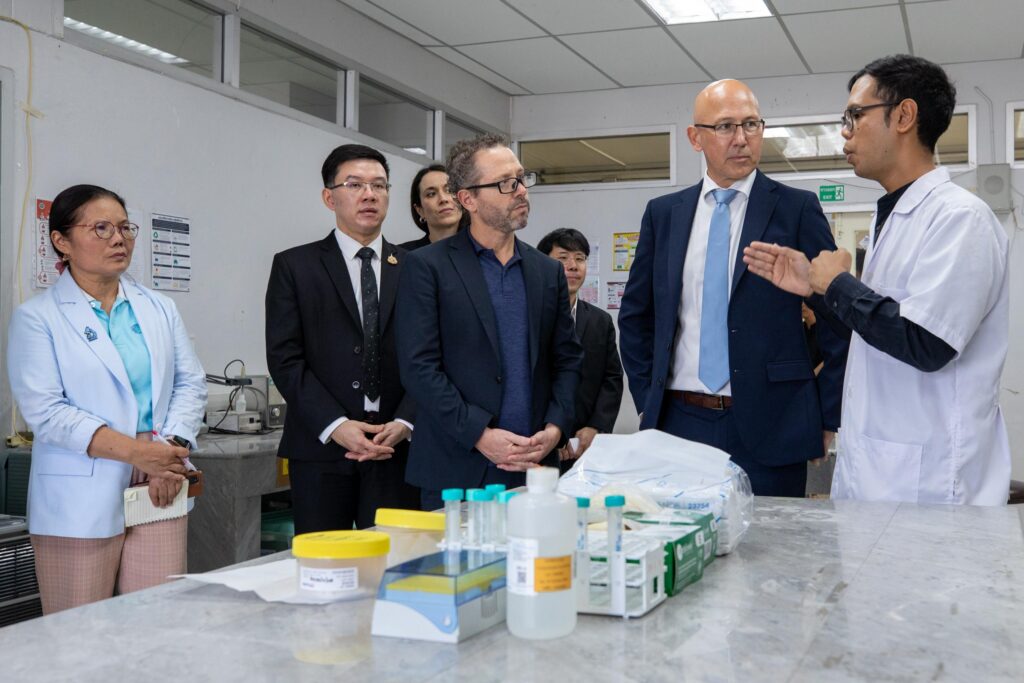
Antimicrobial resistance (AMR) is one of the most pressing threats to health security in Southeast Asia and around the world. In this Q&A, Robert Rosenthal — senior programme leader for the ASEAN-UK Health Security Partnership (HSP) programme, implemented by FHI 360 UK and funded by FCDO — discusses workforce, surveillance and laboratory gaps across the region — and what’s working in the fight against AMR. Previously Robert helped to lead the delivery of the Fleming Fund grants programme in Southeast Asia.
FHI 360 UK: What skills gaps do you see in the One Health workforce across ASEAN, and how is HSP helping countries to close them?
Robert: Ten years ago, AMR was new to almost everyone in SEA region, including many of those working in public health, so the focus was often on building basic capacity to produce and share AMR data. Today AMR is firmly on the agenda. ASEAN has a Strategic Framework for Combating AMR through a One Health Approach — a regional action plan under which all member states have agreed to take a One Health approach, with multisectoral and multidisciplinary engagement from governments and stakeholders.
Today the gaps are more at the intersections — precisely where One Health sits. Epidemiologists who can work across human and animal data are still hard to find. So are laboratory staff who are strong across quality systems, susceptibility testing and sequencing. There are too few experienced people to coach and lead the next cohort. Training alone isn’t enough for work this complex; long-term support and mentorship have proven more effective.
HSP invests in people who can multiply capacity. Through the ASEAN+3 Field Epidemiology Training Network, for example, we’re helping epidemiologists who bring a One Health lens to their work become more effective mentors to field epidemiology programmes in other countries. Through SEAOHUN’s One Health Fellowship, supported by an HSP peer exchange award, professionals from human, animal and environmental health spend four months embedded in a regionally recognised host organisation. They return to their jobs with working relationships, not just knowledge. And in Timor-Leste, we’re helping create the country’s first cohort of certified food-laboratory trainers, including in AMR monitoring, as part of a larger project to support ASEAN’s newest member in launching its first national food laboratory.
How can vets, laboratory scientists, environmental health officers and clinicians be encouraged to work together on AMR when they often sit in different ministries?
What I have seen work is a combination of two things: a formal arrangement for functions and sectors to work together — such as agreements, shared work programmes or One Health coordination terms of reference — and regular opportunities for those actors to work together and reinforce that collaboration. This matters because all too often good ideas never become good practice. Good practice only becomes real when it is practised, which means repetition, after-action review and continuous improvement. When teams from different disciplines learn to do their jobs better together, it creates a virtuous cycle, with everyone pulling in the same direction.
In Cambodia, Lao PDR and Viet Nam, our grantee Health Poverty Action’s ARISE project puts governance first — establishing formal multisectoral coordination committees, then agreeing how data will move across borders and sectors — and tests those arrangements through joint simulation exercises. In AMR, where technical protocols, laboratory skills and field skills need to be perfected over time, we are also funding several projects that give teams practice on real problems. Streptococcus suis is a good example: It lives in pigs, can make people seriously ill, and we know little about why so much resistance is associated with it. Our grantee OUCRU is working with animal and human health laboratories in Lao PDR and Myanmar to find out.
Much AMR surveillance still focuses on hospitals. Why track resistance in animals, food systems and the wider environment?
Clinical settings are actually the tail end of a long chain of events that leads to resistance, so we need to keep moving further up that chain. The selection pressure comes earlier: first through antimicrobials in the feed and medicines given to livestock and aquaculture, then through food chains, and through residues and resistance genes in water. Further upstream still are the points where zoonotic pathogens spill over from wildlife and nature into our food system. We need data to tell us where resistance is coming from.
Environmental AMR surveillance is where ASEAN — and our own portfolio — has furthest to go. It is a priority as we look at future investment.
Where are the biggest opportunities to link animal health and environmental data with human health surveillance?
A couple of places come to mind. First, the Mekong, where the river dominates agriculture and major livestock value chains cross borders. Second, provinces where human and veterinary laboratories already sit side by side or close to one another. In both, the bigger issue is having the data-sharing agreements and protocols that allow people to act quickly.
One example is our support to NIHE in Viet Nam, which has just started piloting integrated One Health surveillance in provinces, with the national veterinary institutes as partners. That brings animal and human laboratory data — and people — together where outbreaks first appear.
Why does subnational capacity matter so much for AMR? What happens when provinces and districts can’t diagnose resistant infections quickly?
Most resistant infections begin far from the capital, where national reference laboratories and central surveillance teams are usually based. Cases show up in places where doctors lack the tools or knowledge to identify what is going on, so they have to guess. The patient wants to be treated quickly and the doctor wants to provide treatment quickly — so the stage is set for broad-spectrum antibiotics to be prescribed without evidence of which pathogen is causing the illness, or whether it has developed resistance to specific antibiotics.
In most countries in the region, national public health institutes and national reference laboratories are tasked with helping subnational laboratories develop quality assurance systems and strong surveillance practices. The aim is to push as much capacity as possible down to the local level, so that local labs can report their findings up the chain. Ideally, new protocols, antibiograms and clinical guidance then flow back down, built from those local findings. None of this can happen without subnational capacity. That is why several countries in the Regional Public Health Laboratories Network, an HSP grantee, are mentoring peers in Myanmar, Lao PDR and Timor-Leste.
In Viet Nam, HSP is supporting work to enhance disease surveillance and laboratory systems at the provincial level to detect outbreaks earlier and respond faster. What does that look like on the ground?
Viet Nam has great, dedicated people working in its health system, but it is dealing with a lot of change. Last year the country reduced its number of provinces from 63 to 34 and moved from three tiers of local government to two. That was a big change for surveillance: catchment areas, reporting lines and laboratory networks all shifted at once. With NIHE, whose project started in October, we’re helping three provinces — Quang Ninh in the north, Khanh Hoa in the centre and Can Tho in the Mekong Delta — pilot an integrated provincial model within the new system. The benefit is time. Outbreaks can be picked up while they are still local, and pathogens identified with more confidence. Health services can then respond before cases multiply.
For HSP’s grantees, beyond capacity, what we really want to see is that this ongoing work — training, mentoring, sharing and continuous improvement — becomes part of everyday practice, led and sustained by the countries themselves.