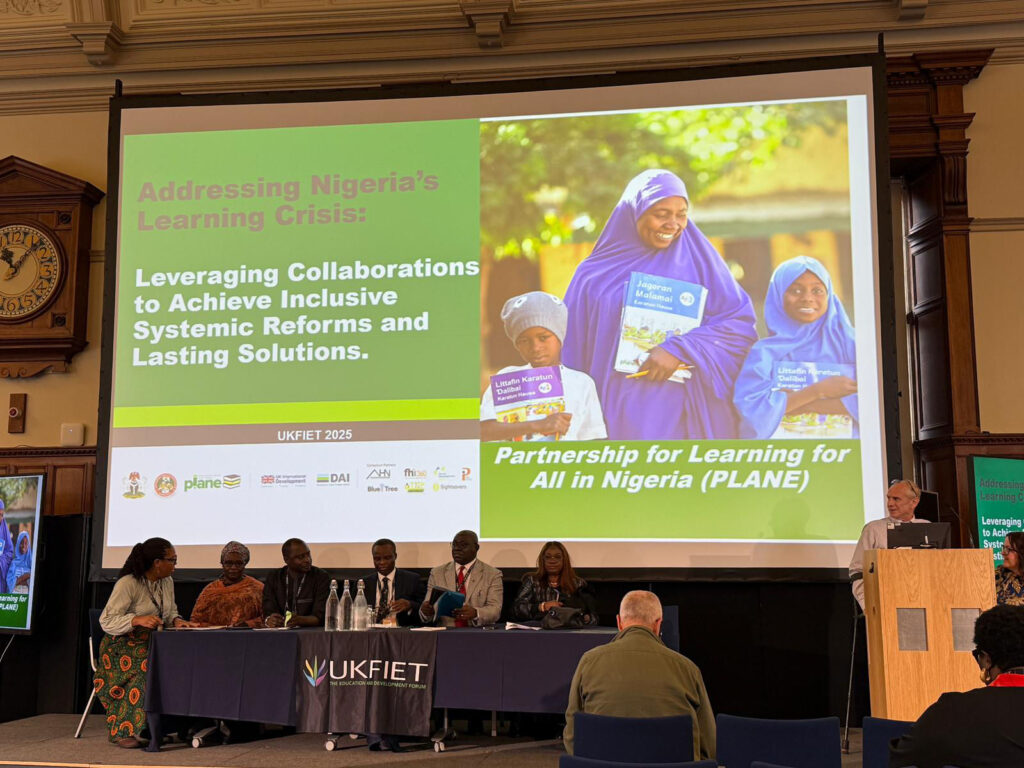
I also want to acknowledge the important contribution of FHI 360 UK and FHI 360 at UKFIET 2025, presenting in two panels across the three-day conference. FHI 360 UK’s contribution to UKFIET 2025 through the FCDO-funded Partnership for Learning for All in Nigeria (PLANE) programme was a standout example of systems-focused reform in action. Leading Output Onex, FHI 360 presented lessons from its work strengthening foundational learning through embedded TA, a model that prioritises working within government systems to build long-term capacity and ownership. Presenters discussed how the programme navigates complex governance structures, builds local ownership through partnerships with ministries and civil society, and uses data to inform policy and practice. Delegates appreciated the programme’s emphasis on context-sensitive design, the prioritisation of foundational learning, and the use of embedded TA as a sustainable alternative to short-term technical cooperation.
In a donor landscape marked by shrinking budgets, embedded TA is emerging as a lower-cost, potentially more sustainable model for supporting education reform. Its strength lies in working within government systems, building capacity, and fostering long-term ownership, rather than delivering short-term results through external interventions. But as several speakers at UKFIET 2025 reminded us, this isn’t about choosing between TA and direct delivery. There remains a vital role for direct service provision, particularly in fragile contexts or where systems are not yet ready to absorb reform. The challenge is to strike the right balance: investing in system strengthening while ensuring that learners, especially the most marginalised, continue to receive the support they need now. TA may be slower and less visible, but when done well, it lays the groundwork for lasting change.
Artificial Intelligence in Education: Whose Intelligence? Whose Agenda?
AI was another major theme of the conference, celebrated for its potential, but scrutinised for its risks and the imperfect nature of AI generated outputs. The most urgent critique? AI is only as good as the data it’s fed. And if that data excludes LMIC narratives, indigenous knowledge, or diverse histories, the solutions it generates may be misaligned, biased, or harmful. As one speaker noted: “If the data doesn’t speak our language, AI won’t hear our needs.”
While much of the discourse around AI at UKFIET 2025 focused on its risks and limitations, several sessions also explored its transformative potential, particularly when designed and deployed with equity and context in mind. One presentation emphasised how AI can support personalised learning pathways, helping learners progress at their own pace and according to their individual needs. In low-resource settings, AI-powered tools can assist teachers with lesson planning, formative assessment, and real-time feedback, freeing up time for more meaningful engagement with students. When grounded in local data and co-designed with educators, AI has the potential to bridge gaps in access, improve learning outcomes, and strengthen teacher capacity. The key is not to reject AI, but to shape it, ensuring it reflects different realities and serves as a tool for inclusion, not exclusion. UKFIET 2025 reminded us that with the right safeguards and intentional design, AI can be a powerful ally in building more responsive and resilient education systems.
Innovative Financing: A Promising Shift Toward Smarter Investment
Undoubtedly the new buzzword on the block at UKFIET 2025 was “innovative financing mechanisms”, somewhat unsurprisingly in a landscape marked by aid cuts. This included outcomes-based funding (OBF), impact bonds, and blended finance. These mechanisms also open the door to new partnerships, bringing in social investors, philanthropic actors, and private sector players to share risk and inject capital. This is particularly valuable in contexts where public budgets are constrained and donor funding is unpredictable.
These models often focus on results rather than inputs, encouraging strategic use of resources and incentivising performance. Examples from Ghana, Sierra Leone, Rwanda, India, and Zambia showed how these models can support foundational learning when paired with strong monitoring and government involvement from the outset. As one speaker put it: “We need to stop funding what’s easy to measure and start funding what matters.”
However, in an increasingly high-risk aid landscape where donor funding is shrinking and education providers are under pressure, OBF can be interpreted as risky from an implementer perspective. Organisations may be asked to deliver ambitious results with limited upfront funding, accountable for results even when external factors are at play. In some cases, this model may exacerbate the precarity of the very actors working closest to communities, at a time when many are already closing their doors. The challenge is to design financing mechanisms that are adaptive, inclusive, and balanced, supporting both innovation and stability, and ensuring that risk is shared fairly across the system.
Reflections
The informal conversations over coffee, in corridors, and at the conference dinner were just as valuable. I connected with colleagues from FCDO, Education Outcomes Fund, GPE, UNESCO, and several research institutions, all grappling with similar challenges and opportunities.
UKFIET 2025 didn’t just ask what works, it asked who decides, how is knowledge equally appraised, and how can we build systems that serve all learners. The challenge now is to turn these insights into action through programmes, policies, and partnerships that are equitable, context-aware, and future-focused.