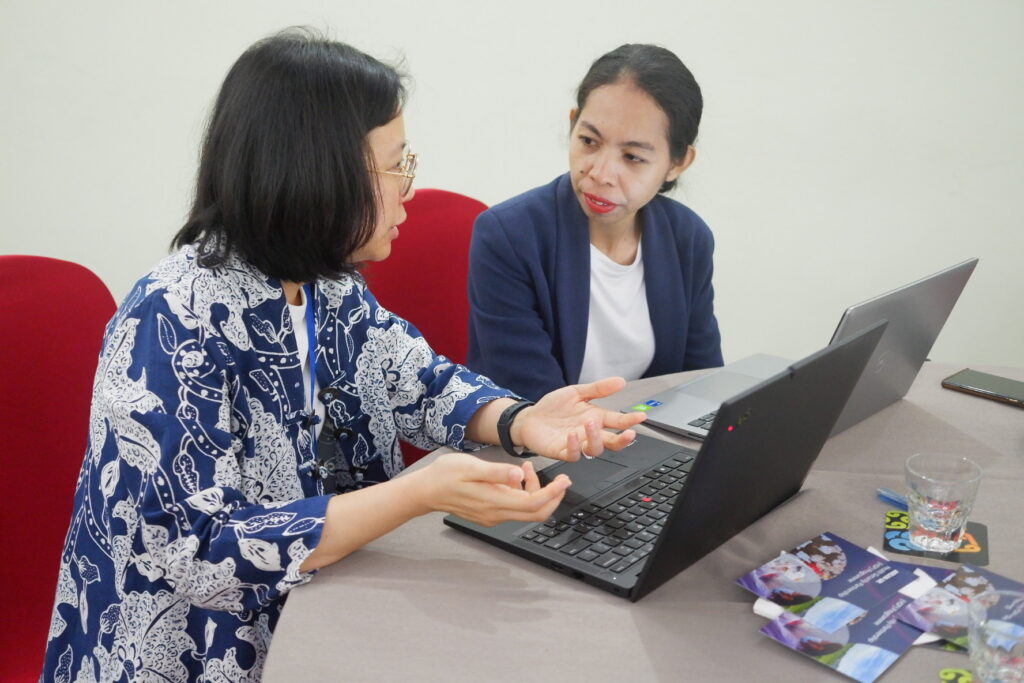
 HSP staff gives a one-on-one session to an applicant to navigate HSP’s approaches, including Thinking and Working Politically.
When COVID-19 pandemic reached Southeast Asia in early 2020, vaccine rollout timelines varied significantly across the region. Cambodia, Indonesia, Lao PDR, the Philippines and Thailand did not begin large-scale vaccination until early to mid-2021. Singapore, by contrast, already procured multiple vaccines through its Pandemic Special Access Route and started inoculating its population in December 2020, becoming the first ASEAN country to do so.
While supply constraints and income levels mattered, these differences also reflected how political priorities, institutional arrangements, and decision-making pathways shaped public health outcomes. Approval processes, procurement rules, diplomatic relationships, and bureaucratic authority all played a part. These dynamics underline why a Thinking and Working Politically (TWP) approach is essential to strengthening health security in ASEAN: technical solutions alone do not determine results, politics matters.
TWP starts with understanding how systems really work: who holds influence and power, how decisions are made, and which formal and informal rules shape behaviour. But analysis on its own is not enough. HSP recognises that the real value of TWP lies in using political insight to guide action so that effort is focused where change is feasible and the balance of power supports change.
Why TWP Matters for HSP
Achieving meaningful and sustainable outcomes in health security goes beyond technical fixes. It depends on understanding incentives, power dynamics, institutional behaviour, and political context. ASEAN’s decision-making is shaped by consensus, non-interference, diverse national systems, and informal norms, all of which demand intentional, politically informed engagement.
TWP is not a checklist. It is a mindset combined with practice. Political economy analysis (PEA) supports thinking politically by helping identify not only what needs to change, but how and where change is realistically possible. Working politically then means using those insights to adapt strategies, manage relationships, and adjust implementation over time.
HSP encourages the application of TWP across grants, peer exchange, and technical assistance to strengthen locally owned and sustainable results, and to deepen ASEAN-UK collaboration through dialogue, trust-building, and joint problem-solving.
HSP has developed a TWP Guidance Paper that sets out what this means in prinicple. In practice, however, TWP often falls short at the point where analysis should translate into action. The common pitfalls below illustrate where this can happen and how to avoid it.
Pitfall #1 – Use Political Economy Analysis (PEA) Once and Never Looking Back (Thinking politically, then stopping)
HSP encouraged applicants to use TWP at the proposal stage. This helped organisations and consortia demonstrate contextual awareness. But if analysis is completed once, filed away, and never revisited, its value quickly erodes as contexts change.
What helps you think politically: Use PEA to surface assumptions, risks, entry points and alternative pathways to change while recognising that these will evolve.
What helps you work politically: Treat PEA as a living input and build in regular “pulse checks” (e.g. quarterly reflections) to test assumptions and adjust activities. Anchor workplans in ASEAN strategic frameworks, such as the ASEAN Plan of Action on Health Development and relevant Health Cluster priorities, to provide continuity and political alignment amid change.
Pitfall #2 – Frameworks Without Friend Networks (Analysis without relationship-based engagement)
PEA is a powerful analytical tool, but it does not replace relationships. When used as a checklist or template, it cannot guide adaption in real time.
What helps you think politically: Use PEA to inform power mapping and identify influential actors, incentives, and institutional pressure points.
What helps you work politically: Invest in relationships as an ongoing strategy. Maintain regular, informal engagement with designated national health focal points from the Ministry of Health throughout implementation, not just at inception or in formal meetings.
Pitfall #3 – Assuming Politics Are Static (Good analysis, rigid about plans)
Political incentives shift. Leadership changes. New policies emerge. When project designs are fixed at the outset, they risk losing relevance and traction over time.
What helps you think politically: Use PEA to identify likely sources of change and uncertainty, including elections, leadership turnover, and policy reform cycles.
What helps you work politically: Revisit strategies as contexts evolve. Regular reflection or “pulse check” allows teams to adapt sequencing, messaging, and engagement approaches. For example, national elections may reshape how to engage on health security domestically and within ASEAN, requiring timely adjustment rather than rigid adherence to original plans.
Pitfall #4 – Underestimating Informal Influences (Formal maps, informal realities)
Formal stakeholder mapping is essential, but it rarely tells the whole story. In many ASEAN contexts, informal networks, personal credibility, and unwritten norms matter as much as formal authority.
What helps you think politically: Look beyond organisational charts to understand who influences decisions informally and how trust is built.
What helps you work politically: Use trust intermediaries, leverage technical credibility , and pay attention to timing and setting. Side conversations, follow-up discussions, and informal exchanges aligned to ASEAN frameworks, Health Cluster priorities, and national plans often create the space for progress where formal channels stall. For example, engage influential actors in side conversations before or after meetings, or during breaks to build rapport or test ideas.
Pitfall #5 – Overlooking Structural Constraints (Ambition without realism)
Structural barriers, such as fragmented governance, centralised decision-making, and sensitivities around national sovereignty, shape what is feasible. These constraints cannot always be shifted within a project timeframe.
What helps you think politically: Use PEA to distinguish between constraints that can be influenced and those that must be navigated.
What helps you work politically: Adapt expectations, timing and delivery approaches to match realities. Focus on achievable gains like building trust, improving coordination or strengthening informal collaboration and network rather than attempting structural reforms beyond the project’s scope.
From Thinking to Working Politically
TWP is not only about getting the analysis right (thinking politically). It is acting on that analysis consistently, with a focus on adaptation and with political awareness. Thinking politically helps identify where change is possible. Working politically turns that insight into action over time.
By avoiding these common pitfalls, HSP-funded projects can better navigate ASEAN’s complex institutional and political realities and increase the likelihood that health security efforts lead to meaningful, lasting impact.