
Home > Helping communities in northeastern Nigeria build resilience: A Q&A with Elvis Ogweno
Helping communities in northeastern Nigeria build resilience: A Q&A with Elvis Ogweno
- 21st October 2026
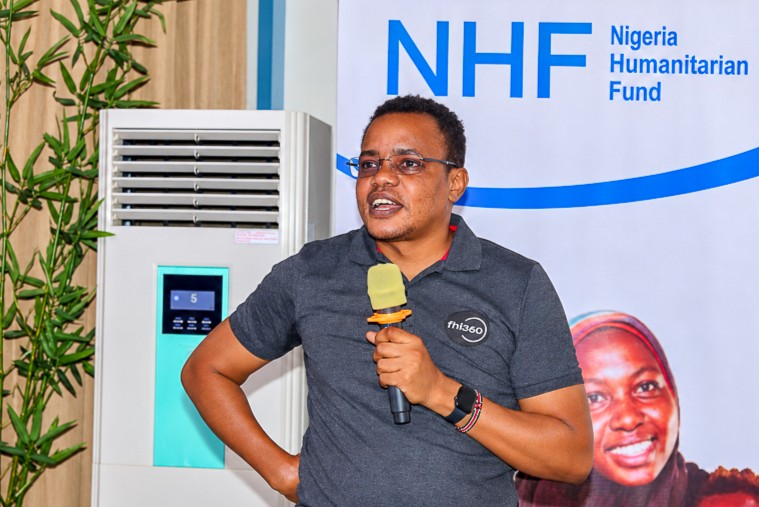
In northeastern Nigeria, challenges like disease outbreaks, malnutrition, flooding, and protracted conflict have left communities struggling to access basic services.
Elvis Ogweno, Chief of Party for the Integrated Humanitarian Assistance in Northeast Nigeria (IHANN) project, is a humanitarian leader who has worked in the region with FHI 360, and now FHI 360 UK, since 2020. He has spent more than a decade managing emergency response and recovery programs in fragile and conflict-affected settings around the world.
Here, he discusses why services must be integrated to be effective, the power of local partnerships, and what it takes to build community resilience.
FHI 360 UK: You've worked in 27 countries. What first drew you to humanitarian work, and what keeps you in it?
Elvis Ogweno: I was raised in a missionary family. We ran medical camps in different countries with volunteer doctors, nurses and surgeons. My upbringing taught me how to help people one at a time, and that humanitarian mindset stayed with me.
I volunteered with St. John Ambulance for many years and was part of the rescue after the 1998 bomb blast at the U.S. Embassy in Nairobi, Kenya. I then trained as a paramedic in South Africa and worked in some of the most hostile environments like Afghanistan, Iraq, Somalia, South Sudan, Yemen and Democratic Republic of the Congo. When Ebola broke out in West Africa, I moved from my job at the UN and joined the International Medical Corps in Liberia for the Ebola response.
Across 27 countries, one thing has stayed consistent: When people lose access to health care, clean water, food and protection, even the most basic service can become a matter of life and death.
What keeps me in this work is knowing our intervention can save lives, restore dignity and help communities regain hope.
FHI 360 UK: What does integration look like on the ground?
Elvis Ogweno: Integration means a family shouldn’t have to navigate separate, disconnected systems to get the services they need. Health, nutrition, WASH and protection should be closely linked — in reality, not just in the project proposal.
Imagine a mother bringing her child with diarrhea to one of our health facilities. The health team treats the child and screens them for acute malnutrition, referring them to nutrition treatment if needed, and the mother receives infant feeding counseling. Because diarrhea might be caused by unsafe water, our WASH team visits the family to promote safe water handling and hygiene, and our protection team can provide dignity kits to the mother. Wherever a person reports first, our staff are trained to connect them to other services.
We also link them with other partners. A mother with a sick baby can’t go out to find food, so we connect her to organisations providing food or cash assistance.
FHI 360 UK: What role do local organisations and Nigerian government institutions play in IHANN's work?
Elvis Ogweno: They are essential partners. Government institutions provide leadership and oversight — we can’t work as an island. Local organisations, community groups and elders bring contextual knowledge, trusted relationships, and an understanding of the local language and customs. IHANN works within existing government health and community structures rather than creating a parallel system.
Communities must own a project for it to last. With WASH, for example, we build toilets and provide maintenance tools, but the community forms a “WASH committee” and decides how to maintain them.
FHI 360 UK: What is needed to build community resilience in fragile settings like northeast Nigeria?
Elvis Ogweno: Involve the community in every discussion, even when writing proposals. Elders might say, “We appreciate your help, but we already have this. We need something else instead.” Then we work with the government and other partners to avoid duplication of services and provide what we call an area-based implementation, where every partner brings something different that they are strong in. When communities see you listening, it builds their hope and dignity — and long-term resilience.
Security is also a major component. In camps for internally displaced people, everyone lives within a small bubble where they cannot farm [due to a lack of space]. It’s hard to build resilience in that bubble.
FHI 360 UK: How is protection embedded within your work?
Elvis Ogweno: In displacement camps, protection should be #1 in everything. It must be built into the project — it’s everyone’s responsibility. People should be able to access services safely, with dignity and without discrimination. That’s why even our temporary facilities have ramps for people with disabilities.
When someone discloses violence, trained staff follow safeguarding procedures and, with informed consent, make confidential referrals. Suggestion boxes collect hundreds of feedback messages each month, which we track on a dashboard until each is resolved.
In humanitarian work, no one is a hero; everyone plays a key role.
Our objective is not simply to deliver services, but to strengthen local systems so that if we came back in 10 years, the facility would be under the community’s control — and even better than the way we left it.